David's Astronomy Pages (Projects)
Pulsating Variable
Stars, Short Period

Eruptive
Variables

Variable
Stars
Home
Page

Long Period
Pulsating
David's Astronomy Pages (Projects)
|
Eruptive Variables |
Variable Stars |
Home Page |
Long Period Pulsating |
Short Period Pulsating Variable Stars Example / Project Stars 
ACYG Alpha Cygni stars (Type ACYG) BCEP Beta Cephei stars (Type BCEP) CEP Cepheid variables (Type CEP) | Delta Cepheid | RT Aur | CW W Virginis stars (Type CW) | HR Aur | DSCT Delta Scuti stars (Type DSCT) | GP And | SZ Lyn | PVTEL PV Telescopii stars (Type PVTEL) RR RR Lyrae stars (Type RR) | RR Lyr | RV Ari | RW Ari | SXPHE SX Phoenicis stars (Type SXPHE) | CY Aqr | ZZ ZZ Ceti stars (Type ZZ) | V777 Her (GD 358) | Other Pulsating Variable Star Types
can be found on a separate page :
Long Period Pulsating Variable Stars
Stars whose surface layer periodically expand and contract. The pulsations may be radial or non-radial. A radially pulsating star remains spherical in shape. In the case of non-radial pulsations, the star's shape periodically deviates from a sphere and even neighbouring zones of its surface may have opposite pulsation phases.
Grouped roughly into Short Period and Long Period variables for convenience.
(This web page is for Short Period.
Long Period pulsating variables are placed
on a separate page)
Alpha Cygni stars. Non radially pulsating supergiants. The light changes, with amplitude of the order of 0.1 mag., often seen irregular, owing to the superposition of many oscillations with close periods. Cycles from several days to several weeks are observed.
Back to Top
Beta Cephei stars, or Beta Canis Majoris stars. Stars with visual amplitudes of 0.03 - 0.3 mag. Light and radial velocity vary with periods of 0.1 to 0.6 days. The light curves are similar in shape to the average radial velocity curves, but lag in phase by a quarter of the period, so that maximum brightness corresponds to minimum stellar radius. Most of these stars are probably radial pulsators, but some, such as V469 Per, are non radial pulsators. Many have multiple periods.
BCEPS
A short-period group of Beta Cephei stars.
Both their periods (0.02-0.04 days) and their light amplitudes (0.015
to 0.025 mag) are smaller by an order of magnitude than in normal BCEP stars
Back to Top
Cepheid variables. Radially pulsating stars of high luminosity (classes
IB - II), with periods in the range 1 to 135 days and visual amplitudes from several
hundredths of a magnitude up to 2 mag. (amplitudes are greater in the B band than
in V light). Spectral type at maximum light is F; at minimum, the types are
G-K. The longer the period of light variation, the later is the spectral type. The
maximum of the surface-layer expansion velocity almost coinciding with maximum light.
CEP(B)
Cepheids (TU Cas, V 367 Sct) displaying the presence
of two or more simultaneously operating pulsation modes (usually the fundamental
tone with the period P0 and the first overtone P1). The periods P0 are in the range
from 2 to 7 days, with the ratio P1/P0 approx. 0.71.
DCEP
These are the classical cepheids, or Delta
Cep-type variables. Com- paratively young objects that have left the main sequence
and evolved into the instability strip of the Hertzsprung-Russell (H-R) diagram,
they obey the well-known Cepheid period-luminosity relation and belong to the young
disk population. DCEP stars are present in open clusters. They display a certain
relation between the shapes of their light curves and their periods.
DCEPS
These are Delta Cep variables having light amplitudes <0.5
mag in V (<0.7 mag in B) and almost symmetrical light curves (M-m approx. 0.4
- 0.5 periods); as a rule, their periods do not exceed 7 days. They are probably
first-overtone pulsators and/or are in the first transition across the instability
strip after leaving the main sequence (SU Cas).
Traditionally, both Delta Cep and W Vir stars are quite often called Cepheids because it is often impossible to discriminate between them on the basis of the light curves for periods in the range 3 - 10 days. However, these are distinct groups of entirely different objects in different evolutionary stages. One of the significant spectral differences between W Vir stars and Cepheids is the presence, during a certain phase interval, of hydrogen-line emission in the former and of Ca II H and K emission in the latter.
Back to Top
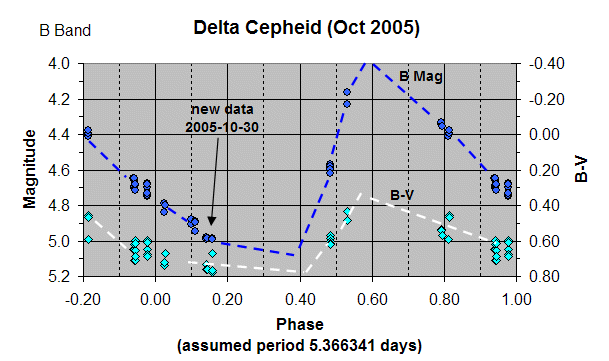
As part of an ongoing project examining the variability in Delta Cepheid, further image sets of the variable star & the reference star SAO 34542 were recorded at around 19:46h UT and 21:42h UT (2005-10-30). Image sets comprised 7 sequences of 3 x 0.2s V & 3 x 0.6s B (alternated between Delta Cepheid & reference star). These were analyzed using the methodology described under 2005-10-05 Notes, and combined with previous estimates
|
B Band Magnitude estimates for Delta Cepheid |
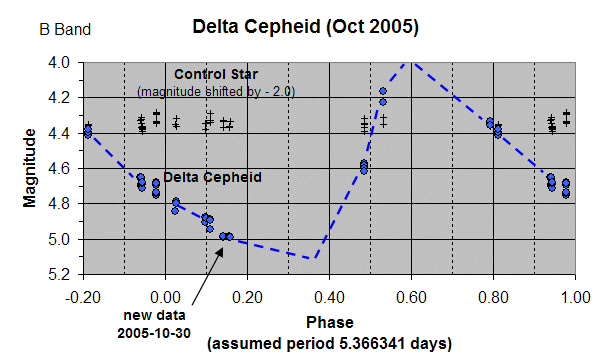 |
| Magnitude and colour variation in Delta Cepheid based on observations on 7 observing sessions between 2005-10-02 and 2005-10-30. |
 |
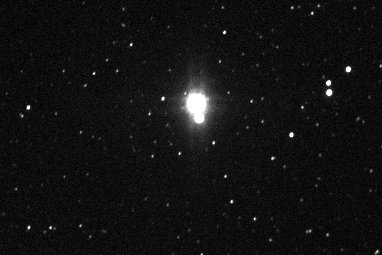
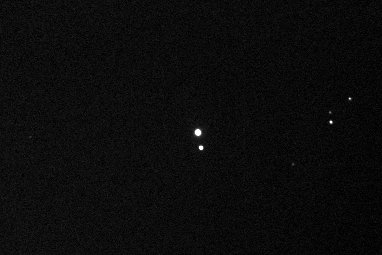
| Delta Cepheid (Cepheus) [ Delta Cepheid is the brightest star , mag +3.6 SAO 34506 is located nearby (41 arc sec separation) ] |
|
| CCD Image 10s exposure, C filter 2005-10-02 21:41h UT (#96081) |
| Delta Cepheid through photometric filter (V) |
|
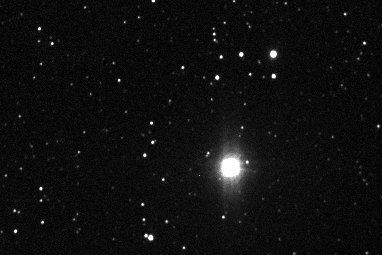
| CCD Image 1s exposure, V filter 2005-09-30 21:54h UT (#96126) |
| Nearby Reference Star SAO 34542, Alpha Lacertae ( Lacerta) Mag +3.8 |
|
| CCD Image 10s exposure, C filter 2005-10-02 21:49h UT (#96108) |
Back to Top
As part of an ongoing project examining the variability in the cepheid
star RT Aur, further image sets of the variable were recorded at the commencement
of the session. Image sets comprised 7 sequences of images (3
x 2s V & 3 x 5s B) alternated between RT Aur & reference star SAO 78571.
These and previous image sets from previous session from Feb-May 2006 were analyzed.
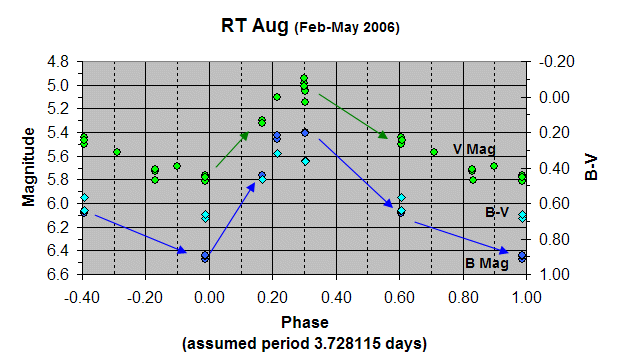
Results are shown in graphs below. Data is consistent with a regular variation
with a period of 3.728115 days. Quality control for this variable is less
tight than ideal due to the faintness of the available check star (particularly
in B). Data quality, particularly in B Band, suffered from increasing Airmass
through May, which hampered ability to confirm B-V trends through the magnitude
minima. Nevertheless the light curve for RT Auriga has been reasonably well constrained
by the total dataset.
[ More
Notes on RT Aur Analysis & Results ].
|
V Band Magnitude estimates for RT Aug |
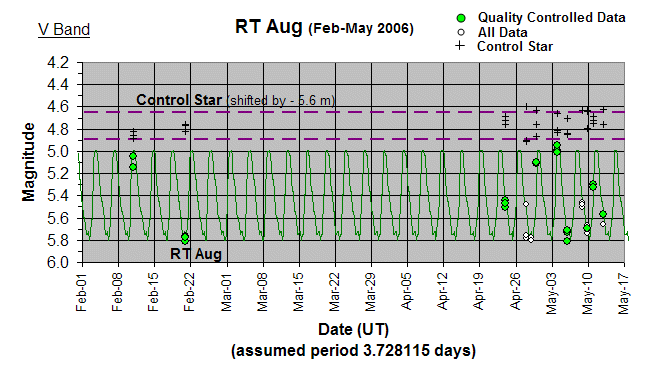 |
| Light Curve for RT Aug Magnitude and colour variation in RT Auriga based on observations on 12 observing sessions between 2006-02-10 and 2006-05-12 [ Reference Star SAO 78571 ] |
 |
|
RT Aur (Auriga) |
 |
| CCD Image (50% size) 60 sec exposure, 1x1 binning, C Filter 2006-02-10 22:11h UT (#114120) |
Back to Top
Variables of the W Virginis type. These are pulsating variables of the galactic spherical component (old disk) population with periods of approximately 0.8 to 35 days and amplitudes from 0.3 to 1.2 mag in V. They obey a period-luminosity relation different from that for Delta Cep variables (see DCEP). For an equal period value, the W Vir variables are fainter than the Delta Cep stars by 0.7 - 2 mag. The light curves of W Vir variables for some period intervals differ from those of Delta Cep variables for corresponding periods either by amplitudes or by the presence of humps on their descending branches, sometimes turning into broad flat maxima. W Vir variables are present in globular clusters and at high galactic latitudes.
They may be separated into the following subtypes:
CWA
W Vir variables with periods longer than 8 days
(W Vir)
CWB
W Vir variables with periods shorter than 8
days (BL Her).
Back to Top
|
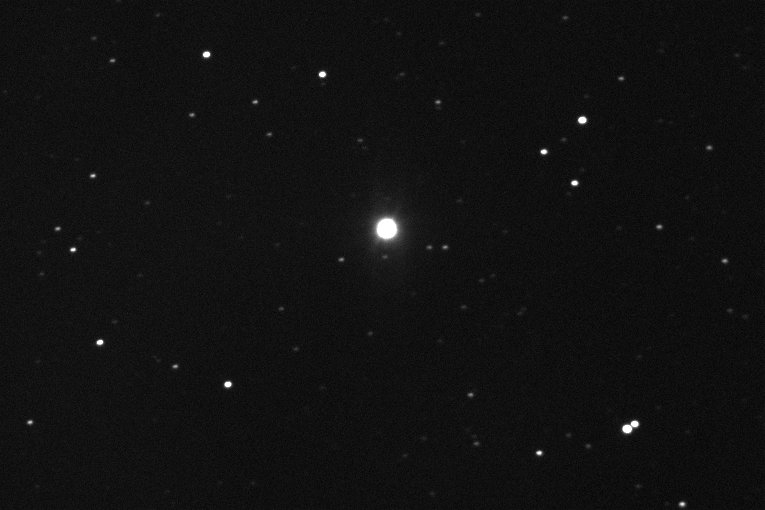
HR Aur (Auriga) |
|
|
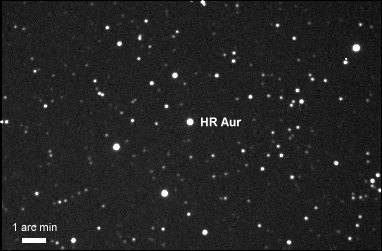
| Annotated CCD Image 3 x 60s sec exposure (average combine), 2x2 binning, C Filter 2008-12-02 20:53h UT (#330109-15) |
|
|
|
HR Aur - reference stars |
|
|
| Annotated CCD Image 60s sec exposure, 2x2 binning, V Filter 2008-12-02 20:51h UT (#330110) |
|
|
|
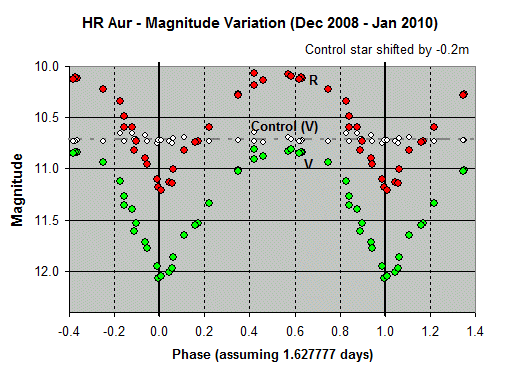
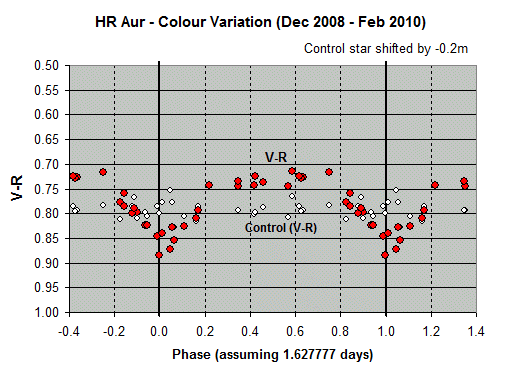
HR Aur - variation |
|
|
|
|
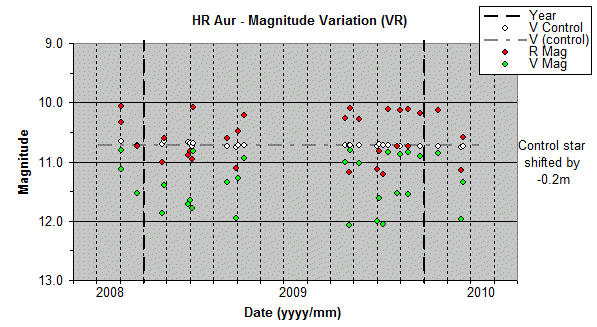
|
Back to Top
Variables of the Delta Scuti type. These are pulsating variables
of spectral types A0-F5 III-V displaying light amplitudes from 0.003 to 0.9 mag
in V (usually several hundredths of a magnitude) and periods from 0.01 to 0.2 days.
The shapes of the light curves, periods, and amplitudes usually vary greatly. Radial
as well as nonradial pulsations are observed. The variability of some members of
this type appears sporadically and sometimes completely ceases, this being a consequence
of strong amplitude modulation with the lower value of the amplitude not exceeding
0.001 mag in some cases. The maximum of the surface layer expansion does not lag
behind the maximum light for more than 0.1 periods. DSCT stars are representatives
of the galactic disk (flat component) and are phenomenologically close to the SX
Phe variables.
DSCTC
Low amplitude group of Delta Sct
variables (light amplitude <0.1 mag in V). The majority of this type's representatives
are stars of luminosity class V; objects of this subtype generally are representative
of the Delta Sct variables in open clusters.
Back to Top
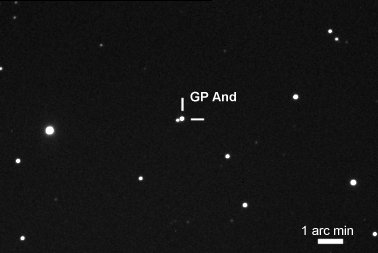
| GP And (Andromeda) [ Catalog mag range +10.4 to +11.0, Type DSCT, Period 0.0786827620 days (1 hr 53m) ] GP And indicated with white markers (estimated magnitude +11.0) Note presence of dim star (GSC 1739:1843, mag +13.3) located 11 arc secs from GP And |
|
| CCD Image 3 x 15s exposure (average combine), 2x2 binning, C Filter 2008-10-04 20:37 hUT (#310074-80) |
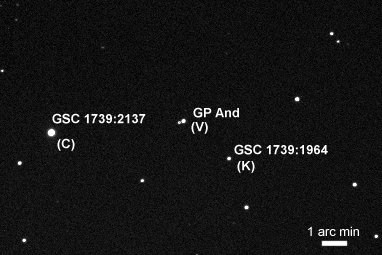
| GP And - Reference Stars |
|
| CCD Image 45s exposure, 2x2 binning, V Filter 2008-10-04 20:33 hUT (#310071) |
Back to Top
|
SZ Lyn (Lynx) |
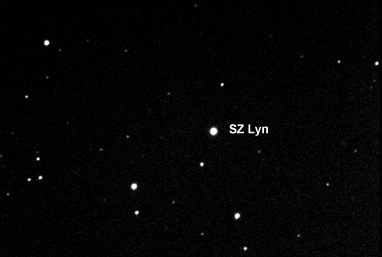 |
| Annotated CCD Image (50% size) 2 x 15s exposure (average combine), 3x3 binning, C Filter 2011-01-14 23:08 hUT (#445093-97) 12" LX200R (at f/9.7) + ST-10XME |
| SZ Lyn - reference stars |
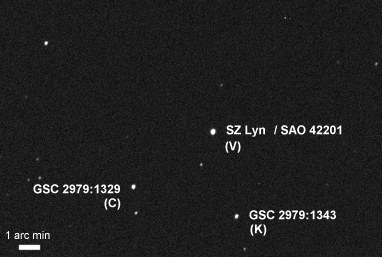 |
| Annotated CCD Image (50% size) 10s exposure (single frame), 3x3 binning, V Filter 2011-01-14 23:07 hUT (#445091) 12" LX200R (at f/9.7) + ST-10XME |
Back to Top
Variables of the PV Telescopii type. These are helium supergiant Bp stars with weak hydrogen lines and enhanced lines of He and C. They pulsate with periods of approximately 0.1 to 1 days, or vary in brightness with an amplitude of 0.1 mag in V during a time interval of about a year.
Back to Top
Variables of the RR Lyrae type, which are radially-pulsating giant
A-F stars having amplitudes from 0.2 to 2 mag in V. Cases of variable light-curve
shapes as well as variable periods are known. If these changes are periodic, they
are called the "Blazhko effect." Traditionally, RR Lyrae stars are sometimes
called short-period Cepheids or cluster-type variables. The majority of these stars
belong to the spherical component of the Galaxy; they are present, sometimes in
large numbers, in some globular clusters, where they are known as pulsating horizontal-branch
stars. Like Cepheids, maximum expansion velocities of surface layers for these stars
practically coincide with maximum light.
A number of subtypes are defined
:
RR(B)
RR Lyrae variables showing two simultaneously
operating pulsation modes, the fundamental tone with the period P0 and the first
overtone, P1 (AQ Leo). The ratio P1/P0 is approximately 0.745;
RRAB
RR Lyrae variables with asymmetric light curves
(steep ascending branches), periods from 0.3 to 1.2 days, and amplitudes from 0.5
to 2 mag in V;
RRC
RR Lyrae variables with nearly symmetric, sometimes
sinusoidal, light curves, periods from 0.2 to 0.5 days, and amplitudes not greater
than 0.8 mag in V (SX UMa).
Back to Top
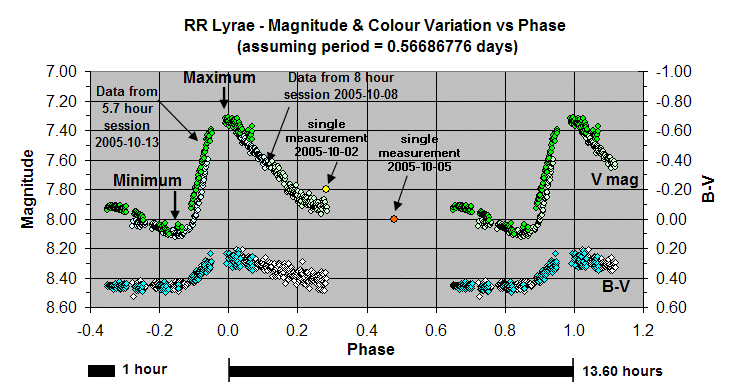
| RR Lyrae (Lyra) | |
|
|
|
|
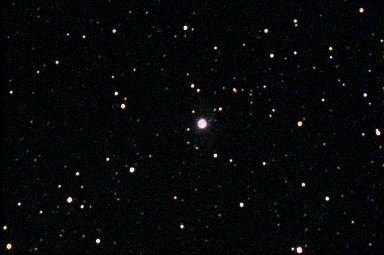
| Approximate Colour CCD Image Red 3 x 10s (av, R Filter), Green 3x10s (V Filter), Blue 3x20s (B Filter) 2005-10-02 20:55h UT (#96020-28) |
|
| RR Lyrae (Lyra) [RR Lyrae (bottom left), reference star SAO 48408 (top right), control star SAO 48415 ] |
|
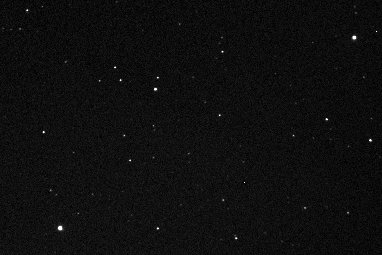
|
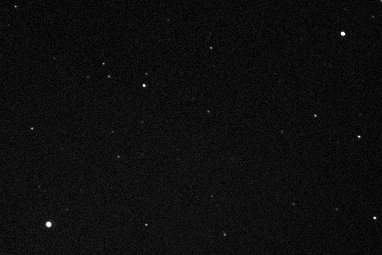
|
| CCD Image (at ~ Minimum) 10s exposure, V filter 2005-10-13 22:48h UT (#99409) |
CCD Image (at ~ Maximum) 10s exposure, V filter 2005-10-14 01:02h UT (#99693) |
| Magnitude Data (B & V Filters) | |
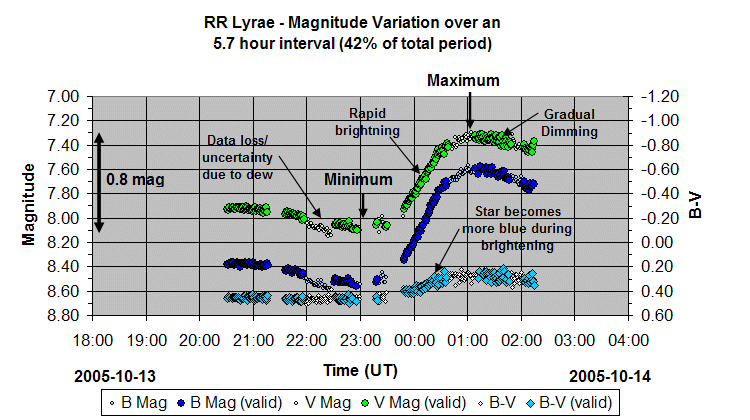
|
|
| Goto RR Lyrae Photometric Analysis Notes | 2005-10-13 Study of RR Lyrae | |
Back to Top
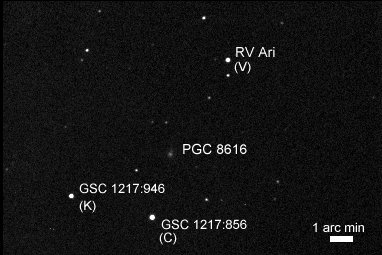
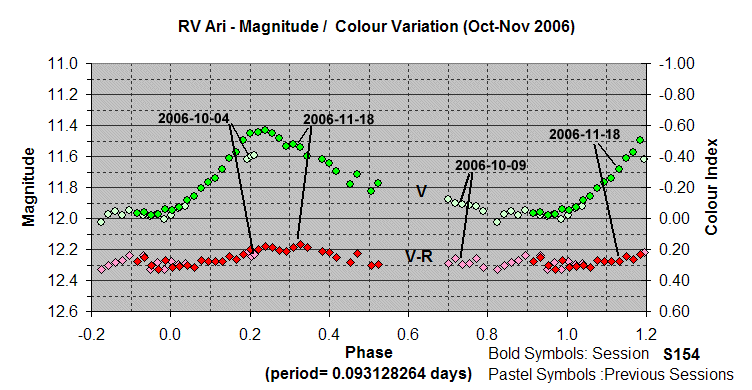
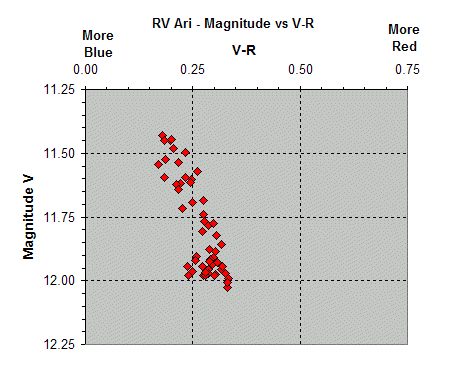
RV Ari is a RR Lyra class variable with with a GCVS catalog period of 0.093128264 days (2 hr 14m) and magnitude min/max of 11.85 to 12.26.
|
RV Ari - Variable Star (Aries) |
|
|
| CCD Image 2 x 30 sec, 2x2 binning (average combine), C Filter 2006-09-04 22:18 h UT (#145055-57) |
| Magnitude Data (V & R Filters) |
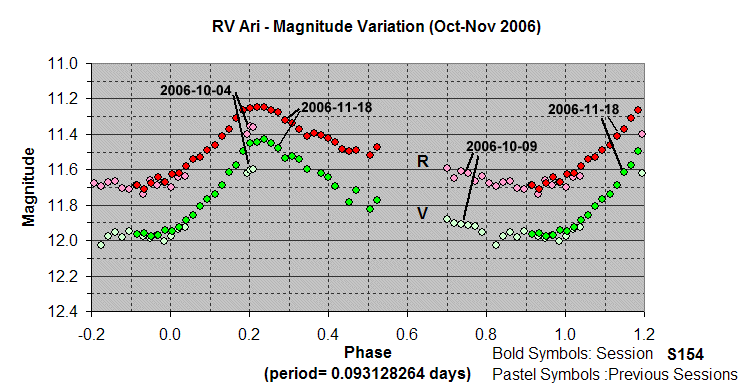
|
|
|
Back to Top
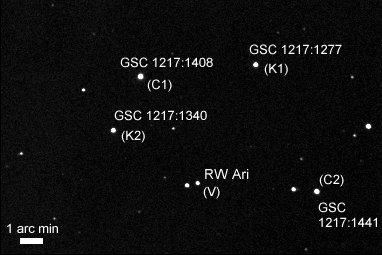
RW Ari is a RR Lyra class variable with a GCVS catalog period of
0.354341 days (8 hr 30m) and magnitude min/max of 12.12 to 12.60.
Baseline images
acquired in B, R,V and C Filters, as preparation for a future observing project.
|
RW Ari - Variable Star (Aries) |
|
|
| Annotated CCD Image 3 x 30 sec, 2x2 binning (average combine), C Filter 2006-09-04 22:32 h UT (#145067-69) |
Back to Top
Short period pulsating subdwarfs (old stars). Periods of 0.04 to
0.08d, with up to 0.7 mag variation.
This type of
star resemble DSCT (Delta Sct) variables and are pulsating subdwarfs of the spherical
component, or old disk galactic population, with spectral types in the range A2-F5.
They may show several simultaneous periods of oscillation, generally in the range
0.04-0.08 days, with variable-amplitude light changes that may reach 0.7 mag in
V. These stars are often present in globular clusters.
|
CY Aqr (Aquarius) |
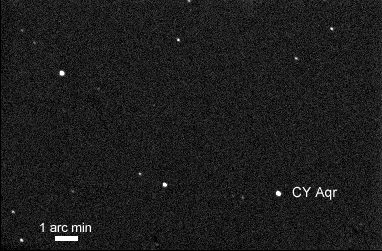 |
| Annotated CCD Image 3 x 30 sec exposure (average combine), 2x2 binning, C Filter 2007-10-22 21:53hUT (#224177-83) |
|
|
|
CY Aqr - Reference Stars |
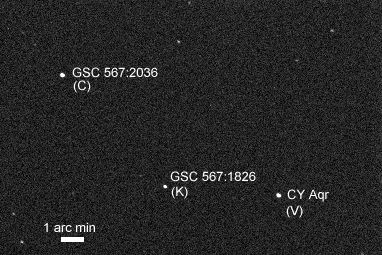 |
| Annotated CD Image 60 sec exposure, 2x2 binning, V Filter 2007-10-22 21:51hUT (#224178 |
Back to Top
ZZ Ceti variables. These are nonradially pulsating white dwarfs
that change their brightnesses with periods from 30 s to 25 min and amplitudes from
0.001 to 0.2 mag in V. They usually show several close period values. Flares of
1 mag are sometimes observed; however, these may be explained by the presence of
close UV Ceti companions. Example:ZZ Cet
These variables are divided
into the following subtypes:
ZZA
ZZ Cet-type variables
of DA spectral type (ZZ Cet) having only hydrogen absorption lines in their spectra;
ZZB
ZZ Cet-type variables of DB spectral type having
only helium absorption lines in their spectra.
ZZO
ZZ Cet type variables of the DO spectral type
showing HeII and and CIV absorpion lines in their spectra.
Back to Top
V777 Her (GD 358) is a pulsating white dwarf whose luminosity varies
due to non-radial gravity wave pulsations. Variations in light output (or around
10-15%), arising from a superposition of several vibrational modes with periods
of hundreds to thousands of seconds. The star has helium dominated atmosphere/spectral
type DB and forms a group of stars know as ZZB, DBV or V777
Her stars.
[
GD 358 Paper 1 ,
GD 358 Paper
2 ]
| V777 Her / GD 358 (Hercules) |
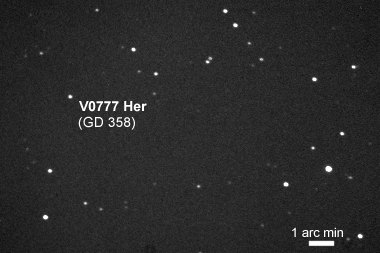 |
| Annotated CCD Image 3 x 60s (average combine), 2x2 binning, C Filter 2008-07-13 00:50 hUT (#294120-24) |
| V777 Her - reference stars |
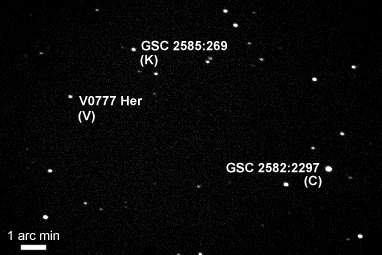 |
| Annotated CCD Image 60s, 2x2 binning, C Filter 2008-07-13 00:48 hUT (#294120) |
| V777 Her - photometric test run A short test run over 25 minutes indicates possible variation of V777 Her with two peaks separated by around 6 minutes (variability of V777 Her values greater than noise in control star values) The magnitude error bars associated with 60s V filter exposures (derived from S/N measurements) are too wide to give useful results moving forward. Whilst longer exposures would have higher S/N and thus smaller error bars the data points would be too sparse to capture the expected rapid variations. Initial points with 60s clear filter exposures have higher S/N and consequently lower error bars and seem more appropriate for future photometric runs on this star |
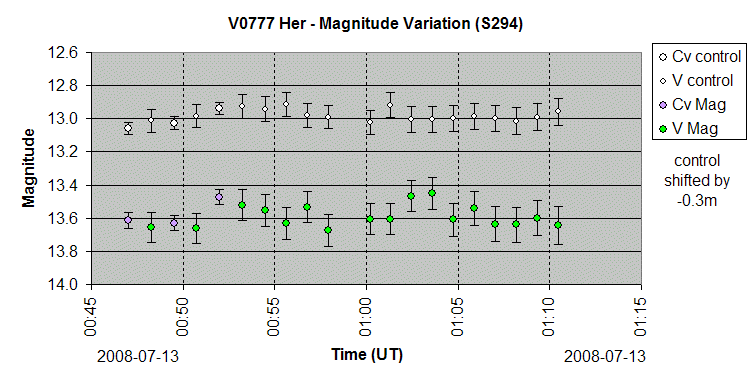 |
| C Filter: 60s, 2x2 binning (#294120-26) V Filter : 60s, 2x2 binning (#294121-40) |
| 777 Her / GD 358 (Hercules) Photometric test run Longer test run over 95 minutes. The test indicates probable variation of V777 Her with a frequency of 6-10 minutes. Note : Error bars associated with measurements of both V0777 Her and the control star generally widen towards the end of the test, reflecting the deteriorating sky conditions with resulting reduction in S/N. |
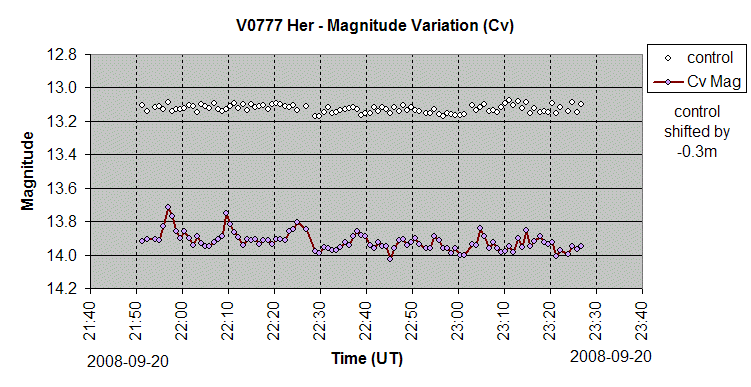 |
| C Filter: 45s, 2x2 binning (#303076-178) |
Back to Top
| This Web Page: | Pulsating Variable Stars, Short Period |
| Last Updated : | 2015-05-15 |
| Site Owner : | David Richards |
| Home Page : | David's Astronomy Web Site |