David's Astronomy Pages
Eruptive
Variable Stars

Eclipsing
Variables

Variable
Stars
Home
Page

Pulsating
Variables
David's Astronomy Pages
|
Eclipsing Variables |
Variable Stars |
Home Page |
Pulsating Variables |
Eruptive Variable Star Types Examples / Project Stars 
BE Be stars (Type BE) FU FU Orionis stars (Type FU) | FU Ori | GCAS Gamma Cassiopeiae stars (Type GCAS) I Irregular variables (Type I) IN Orion variables (Type IN) | T Tau | RR Tau | IS Rapid irregular variables (Type IS) RCB R Coronae Borealis stars (Type RCB) | R CrB | DY Per | RS RS Canum Venaticorum stars (Type RS) | RS CVn | SDOR S Doradus stars (Type SDOR) UV UV Ceti stars (Type UV) | AD Leo | EV Lac | UNV Flaring Orion variables (Type UNV) WR Wolf Rayet variables (Type WR)
Eruptive variables are stars varying in brightness because of violent processes and flares taking place in their chromospheres and coronae. The light changes are usually accompanied by shell events, or matter outflow in the form of stellar wind of variable intensity, or interaction with surrounding interstellar matter.
Be stars showing small-scale variations, sometimes quasi-periodic, not necessarily related to shell events
Back to Top
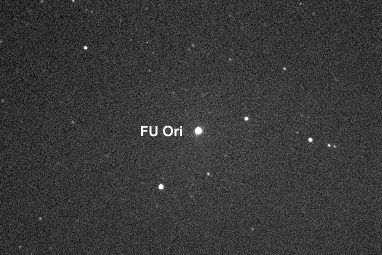
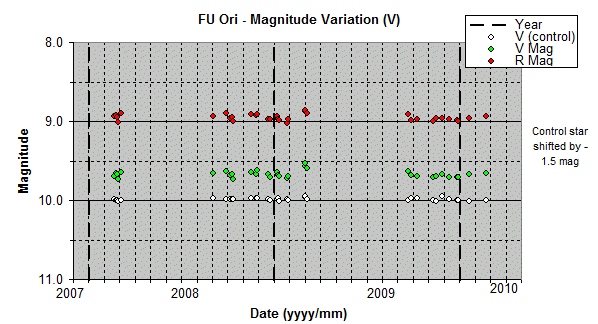
FU Orionis stars, or Fuors. Similar to Orion variables (type IN), but characterised by a gradual increase in brightness by about 6 mag. in 6 months. This is followed by complete constancy at maximum light, sustained for decades, or by a slow decline of one or two magnitudes. These variables probably mark one of the stages in the evolution of T Tauri stars (type INT), sine one T Tauri star, V1077 Cyg, showed a similar outburst, but immediately after maximum brightness had been achieved a fade began, of 2.5 mag in 2111 years. All known Fuors are associated with reflecting cometary nebulae
|
FU Ori (Orion) |
|
|
|
Annotated CCD Image |
Back to Top
|
FU Ori (Orion) |
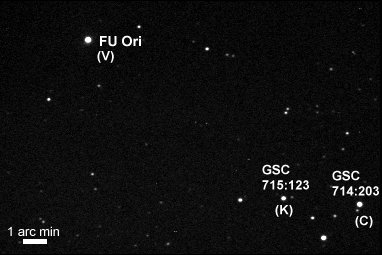 |
| Annotated CCD Image 3 x 60s exposure , 2x2 binning, V Filter 2008-02-24 22:40h UT (#268180-84) |
| FU Ori - photometry |
 |
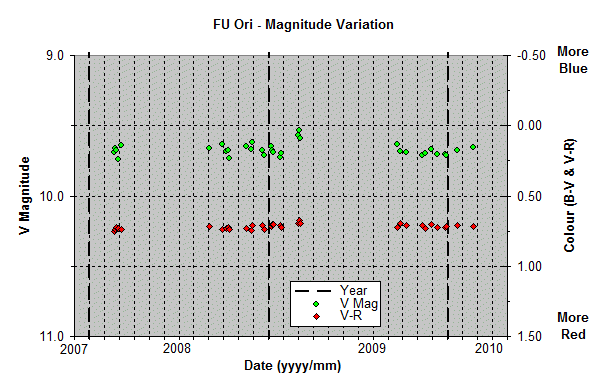 |
Back to Top
Gamma Cassiopeiae stars. Rapidly rotating Be III - IV stars with outflow of matter from their equatorial zone; the formation of equatorial rings or discs is sometimes accompanied by temporary fading of the star. Light variations are irregular and may amount to as much as 1.5 mag. visually. eg Gamma Cas,
Back to Top
Poorly studied irregular variables with unknown features of light variations. A very homogeneous group of objects.
IA - irregular variables of early spectral types
IB - irregular variables of intermediate and later spectral types
Back to Top
Orion variables. Irregular variables associated with bright or diffuse nebulae, or observed in the region of these nebulae. Some of them may show cyclic light variations due to axial rotation. On the H-R diagram they lie in the area of the main sequence and the subgiants. They are probably young objects that are in the course of further evolution will become non-variables stars on the main sequence. The range of brightness variations may reach several magnitudes. A star may be allocated to type INA, INB or INT based on spectral information.
INA - Orion variables of early spectral types, Examples: T
Ori
INB - Orion variables of intermediate and later
spectral types. Examples: BH Cep, AH Ori
INT - T Tauri
stars. Usually only observed in diffuse nebulae. Examples: T Tau, RW Aur.
INS - Orion variables where rapid light changes are observed observed
(INSA - early spectral type, INSB - intermediate-late spectral type, INST - T Tau
type)
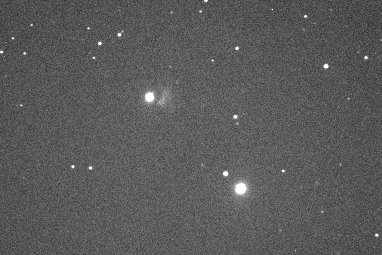
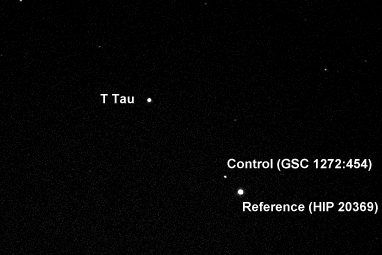
Image sets of T Tauri were recorded at around 23:40h UT (2005-10-13) and 02:45h UT (2005-10-14). Image sets comprised 3 x 15s V and 3 x 60s B.
| T Tauri & adjacent nebula NGC 1555 (Taurus) [ NGC 1555 also known as Hind's variable nebula) |
|
| CCD Image 1 20 sec exposure, C Filter 2005-10-14 02:40 h UT (#99920) |
|
NGC 1555 - "Hind's Variable Nebula" (Taurus) |
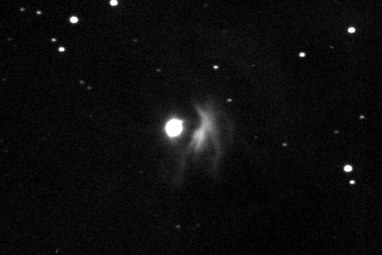 |
| CCD Image (73% size, cropped, Linear brightness scaling) 5 x 60s exposure (average combine), 3x3 binning, C Filter, 2011-01-28 22:11 hUT (#450274-78) 12" LX200R (at f/9.7) + ST-10XME |
| T Tauri Photometry Baseline |
|
| CCD Image 30 sec exposure, V Filter 2005-10-13 23:39 h UT (#99519) |
| Photometry V & B Bands |
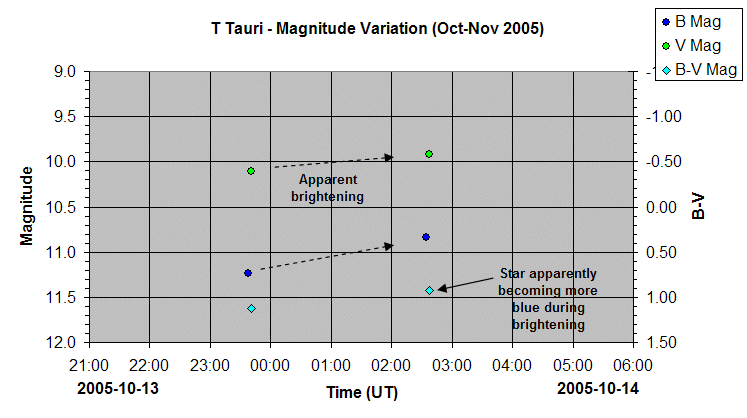
|
| Further observations will be made during future sessions in order to further refine the light / colour variation. |
Back to Top
|
RR Tau (Taurus) |
|
|
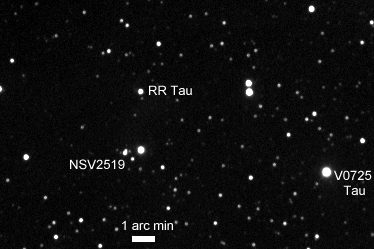
| Annotated CCD Image 3 x 60s exposure (average combine), 2x2 binning, C filter, 2007-03-12 21:17h UT (#182157-69) |
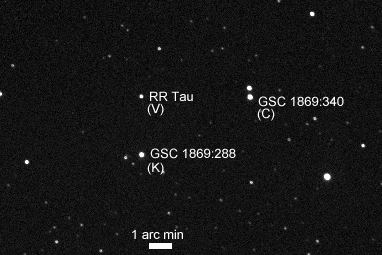
| RR Tau - reference stars |
|
|
| Annotated CCD Image 120s exposure, 2x2 binning, V filter, 2007-03-12 21:10h UT (#182159) |
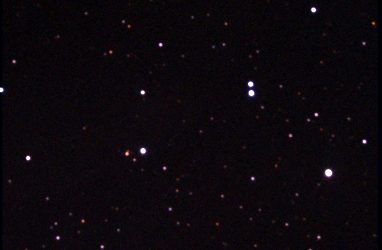
| RR Tau - colour |
|
|
| Approximate Colour CCD Image Blue : 3 x 120s (B) , Green : 3x60s (V), Red : 3x30s(R) 2x2 binning 2007-03-12 21:14h UT (#182158-68) |
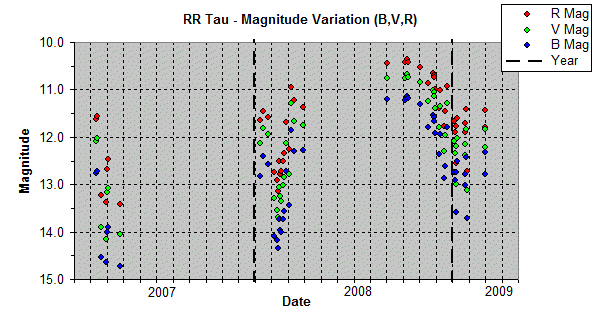
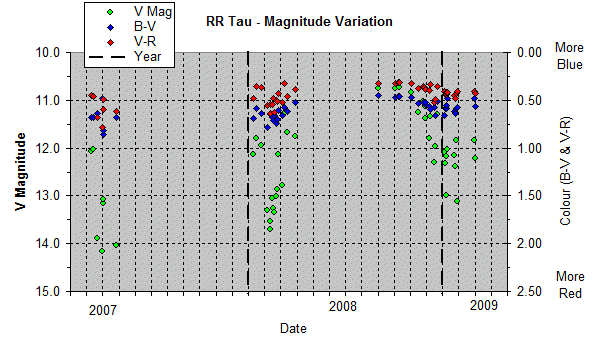
| RR Tau Variation (2007) |
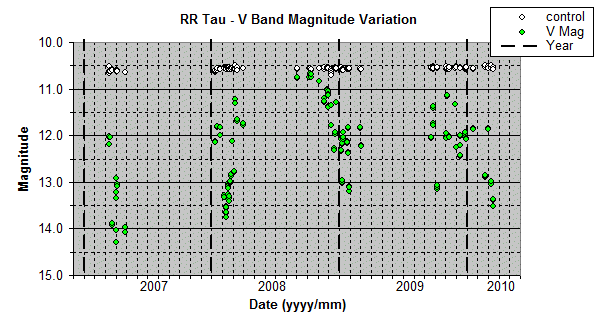
|
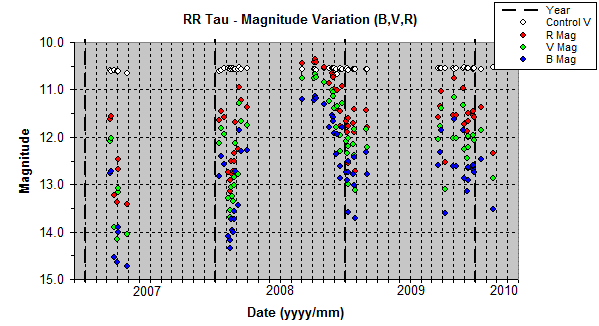
|
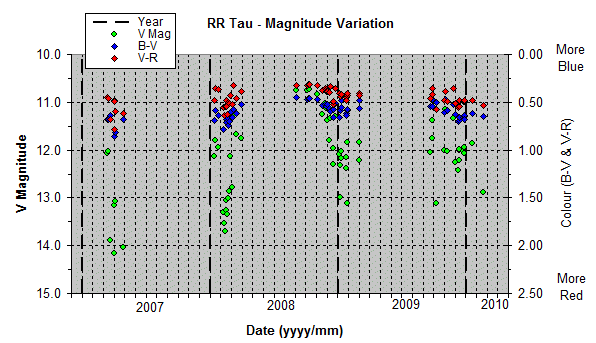
|
| TT Tau Photometry - Feb 2007 to Mar 2009 |
|
|
Back to Top
Rapid irregular variables with no apparent connection with diffuse nebulae, showing light chnages by 0.5 - 1.0 mag. over several hours or days. There is no strict boundary between rapid irregular variables and Orion variables. If a rapid irregular star is observed in the region of a diffuse nebulae it is considered an Orion variable (INS).
ISA
Rapid irregular variables of early spectral types.
ISB
Rapid irregular variables of intermediate and later spectral types.
Back to Top
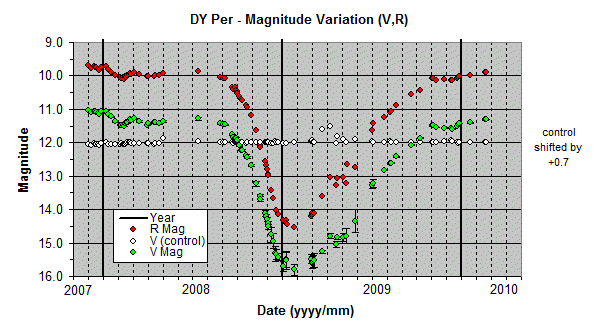
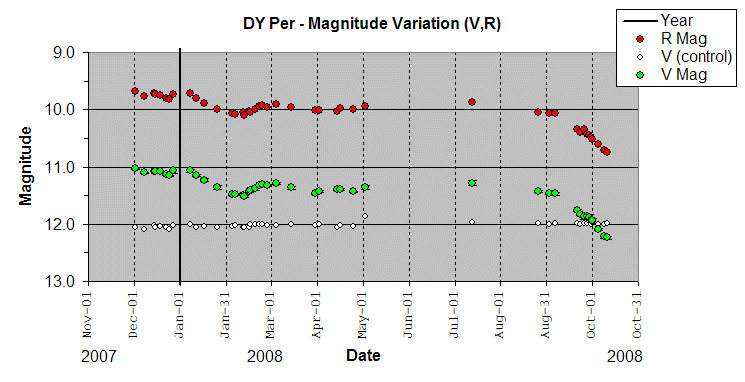
R Coronae Borealis stars. Stars of spectral types Bpe-R of high luminosity, poor in hydrogen and rich in carbon and helium. They are simultaneously eruptive and pulsating variables. Slow non-periodic fades of 1 - 9 mag. last from months to a few years. These are superimposed by cyclic pulsations with amplitudes up to 0.4 - 0.7 mag and periods of 30 - 100 days. Examples: R CrB, DY Per
|
R CrB (Corona Borealis) |
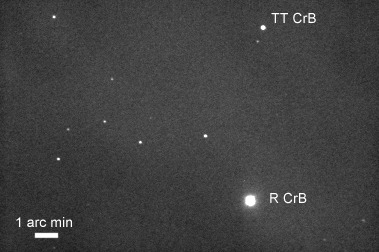 |
| Annotated CCD Image 3 x 30s exposure (average combine), 2x2 binning, C Filter 2006-06-15 01:21 hUT (#128092-94) |
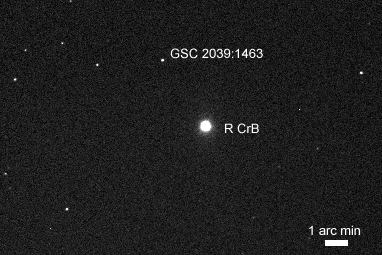 |
| Annotated CCD Image 15s exposure, 2x2 binning, R Filter 2006-09-08 20:52 hUT (#141072) |
| R CrB variation |
|
R CrB - Normal Bright State (2006-06-15) |
|
|
| Annotated CCD Image 3 x 30s exposure (average combine), 2x2 binning, C Filter 2006-06-15 01:21 hUT (#128092-94) |
|
R CrB - Low State (2008-05-02) |
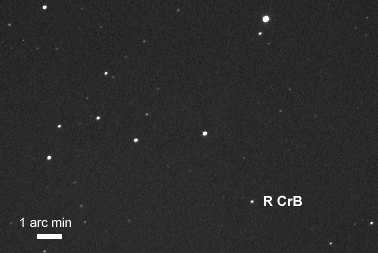 |
| Annotated CCD Image 3 x 30s exposure (average combine), 2x2 binning, C Filter 2008-05-02 23:32 hUT (#285071-73) |
| R CrB (Corono Borealis) |
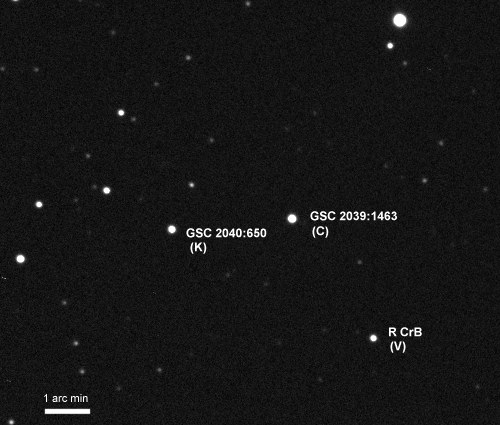 |
| Annotated CCD Image (cropped) 3 x 10s exposure (average combine), 3x3 binning, C Filter 2010-11-03 18:49hUT (#433003-07)) 12" LX200R (at f/9.7) + ST-10XME |
| Light Curve for R CrB |
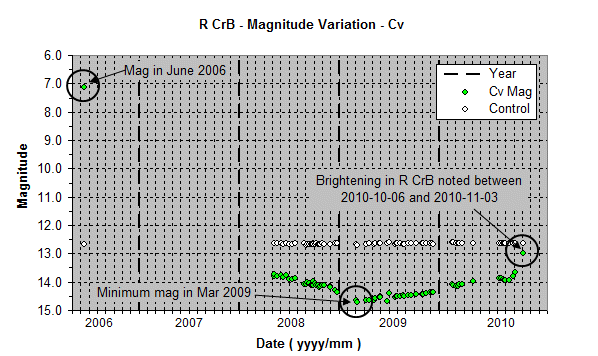 |
Back to Top
| DY Per (Perseus) | ||||||||||||
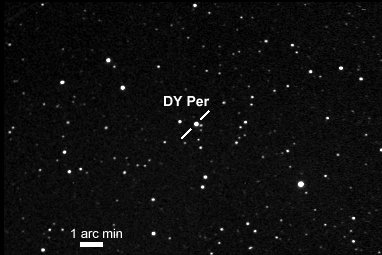
|
||||||||||||
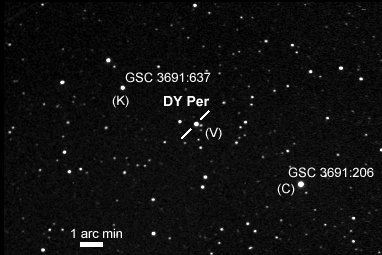
| Annotated CCD Image 3 x 60 sec exposure (average combine), 2x2 binning, V Filter 2007-12-02 05:18h UT (#238067-73) |
||||||||||||
| DY Per - Reference Stars | ||||||||||||
|
||||||||||||
| Annotated CCD Image Details as above |
||||||||||||
|
||||||||||||
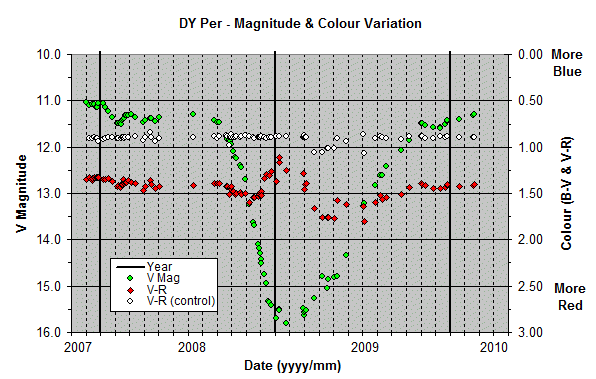
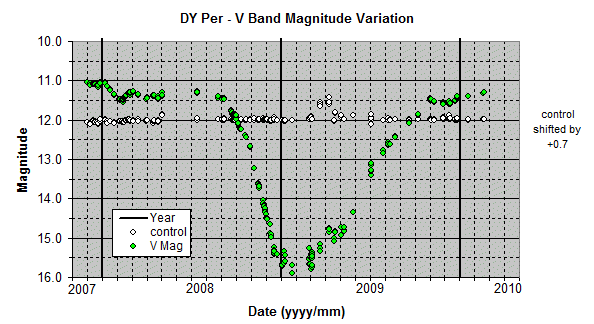
| Photometry results | ||||||||||||
|
||||||||||||
|
||||||||||||
|
||||||||||||
| DY Per variation - Dec 2007 to Oct 2008 | ||||||||||||
|
Back to Top
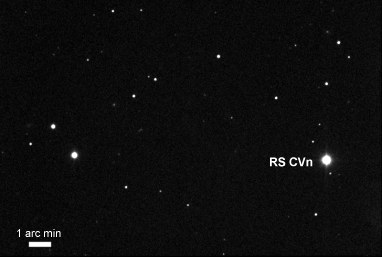
RS Canum Venaticorum stars. Close binary systems. Their components have enhanced chromospheric activity which cause quasi - periodic light variability. The variation period is close to the orbital period an the amplitude is usually at least 0.2 mag. Example UX Ari. They are also X-ray sources and rotating variables. They may also be eclipsing variables as in the case of RS CVn itself.
Back to Top
|
RS CVn (Canes Venatici) |
|
|
| CCD Image (50%) 3 x 15s exposure (average combine), 3x3 binning, C filter, 2010-03-03 00:37h UT (#415152-60) 12" LX200R (at f/9.7) + ST-10XME |
|
|
|
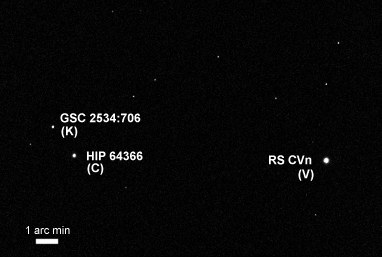
RS CVn - Reference Stars |
|
|
| CCD Image (50%) 5s exposure (single frame), 3x3 binning, V filter, 2010-03-03 00:36h UT (#415154) 12" LX200R (at f/9.7) + ST-10XME |
Back to Top
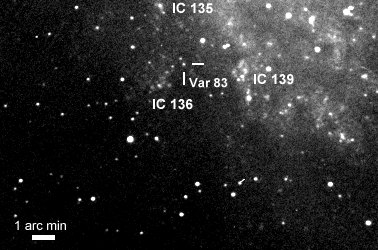
S Doradus stars. High luminosity stars showing irregular (sometimes cyclic) light changes with visual amplitude in the range 1 - 7 mag. They are amongst the most luminous of all stars. S Dor is actually in the Large Magellanic Cloud. they usually associated with diffuse nebulae and surrounded by expanding envelopes. Examples P Cyg, Eta Car.
|
Variable 83 in M33 / S-Dor type variable (Triangulum) |
|
|
| Annotated CCD Image 5 x 3 min exposure (average combine), 2x2 binning, C Filter 2006-11-16 23:24 h UT (#152276-80) ( Image details as above ) |
Back to Top
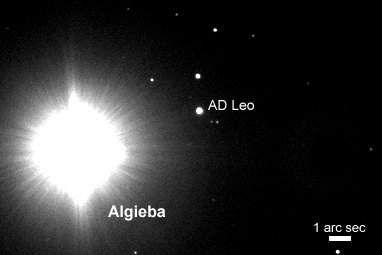
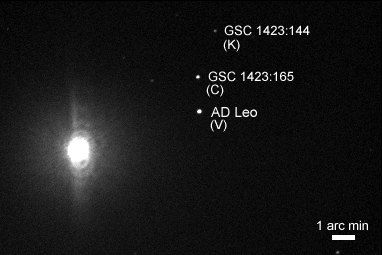
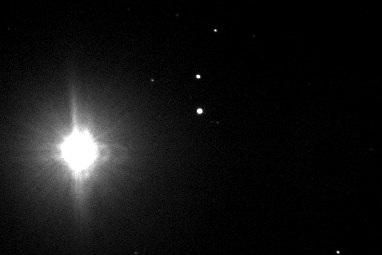
UV Ceti stars, or flare stars. Stars sometimes showing flares of visual amplitude ranging from several tenths of a magnitude up to 6 mag. The amplitude is considerably greater in the ultraviolet. From the beginning of the flare to maximum light takes from seconds to a minute or so. To return to its normal brightness takes from several minutes up to an hour or so.
|
AD Leo (Leo) |
||||||||||||
|
|
||||||||||||
|
Annotated CCD Image |
||||||||||||
|
|
||||||||||||
|
AD Leo - Reference Stars |
||||||||||||
|
|
||||||||||||
|
Annotated CCD Image |
||||||||||||
|
|
||||||||||||
|
||||||||||||
|
|
||||||||||||
|
AD Leo - Short Duration Images Tests |
||||||||||||
|
|
||||||||||||
|
Annotated CCD Image |
||||||||||||
|
|
Back to Top
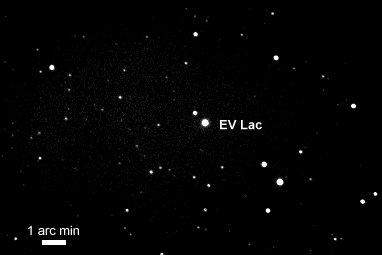
| EV Lac (Lacerta) UV + BY |
|
| Annotated CCD Image 3 x 30 sec exposure (average combine), 2x2 binning, C Filter 2008-06-09 00:22 UT (#290078-82) |
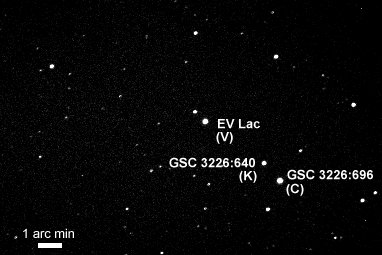
| EV Lac - Reference Stars |
|
| Annotated CCD Image 60 sec exposure, 2x2 binning, R Filter 2008-06-09 00:20 UT (#290079) |
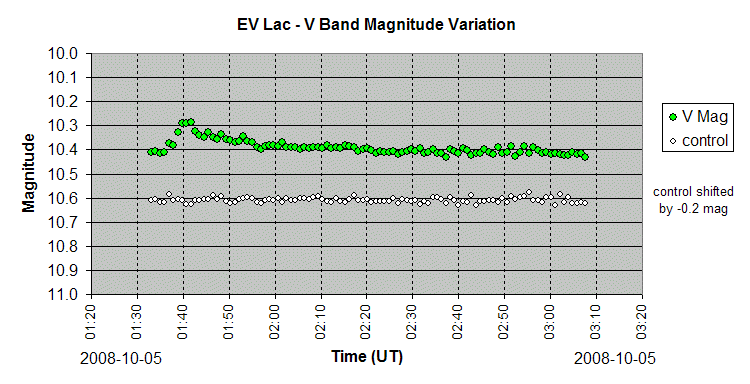
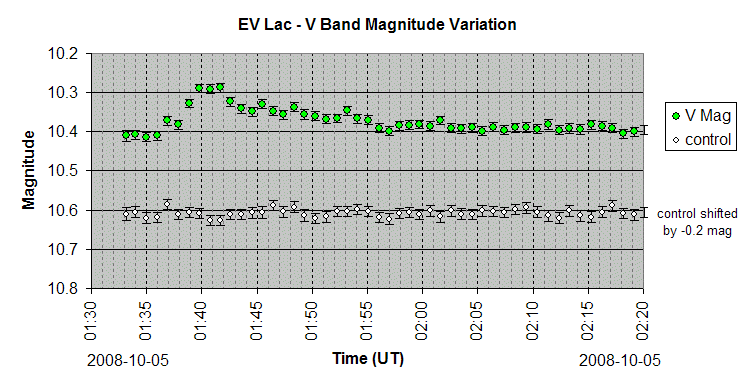
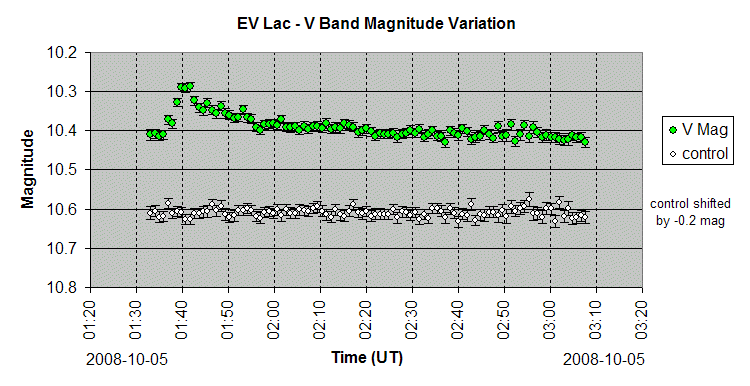
| EV Lac (Lacerta) A 90min time series run was conducted using a V Filter The run successfully caught the rise and decay of a flare (0.1 mag) |
|
| 100 x 45s frames, 2x2 binning, V Filter 2008-10-05 01:33 to 03:08 hUT (#310395-494) |
|
|
| EV Lac flare - detail Flare detected at 01:37hUT (2008-10-05), It took 4 minutes to rise to peak (01:40h) and then took a further 70 minutes to decay away. 0.1 mag brightening at peak. |
Back to Top
Flaring Orion variables of spectral types Ke-Me. Their apparent behaviour resembles that of the UV Ceti stars. Besides being associated with nebulae, UVN stars on average have earlier spectral types than UV stars, greater luminosity an slower development of flares. They may a subgroup of INB variables with irregular variations superimposed by flares . Example: V389 Ori.
Back to Top
Wolf Rayet variables. Display irregular light changes with visual amplitudes up to 0.1 mag., which are probably physical (non-stable matter outflow from their surfaces) rather than geometric (rotation etc).
Back to Top
| This Web Page: | Eruptive Variable Stars |
| Last Updated : | 2015-05-15 |
| Site Owner : | David Richards |
| Home Page : | David's Astronomy Web Site |