David's Astronomy Pages (Projects)
Eclipsing Variables

Cataclysmic
Variables

Variable
Stars
Home
Page

Eruptive
Variables
David's Astronomy Pages (Projects)
|
Cataclysmic Variables |
Variable Stars |
Home Page |
Eruptive Variables |
Eclipsing binary stars systems are classified by a 3 fold system :
according
to the shape of the combined light curve,
according to the degree
of contact between the components (if known)
according to the physical
and evolutionary characteristics of their components.
The classification
based on light curves is simple, traditional, and suits the observers; the second
and third classification methods take into account positions of the binary-system
components in the (MV ,B-V) diagram and the degree of inner Roche lobe filling.
The combination of the above three classification systems results in the assignment of multiple classifications for object types. These are separated by a "/" in the data field. Examples are: E/DM, EA/DS/RS, EB/WR, EW/KW, etc. RT And, for example, is classified as EA/DW/RS
Eclipsing binary systems. These are binary systems with orbital planes so close to the observer's line of sight (the inclination i of the orbital plane to the plane orthogonal to the line of sight is close to 90 deg) that the components periodically eclipse each other. Consequently, the observer finds changes of the apparent combined brightness of the system with the period coincident with that of the components' orbital motion. Further divided into 3 types; EA, EB & EW
| V Sge (Sagitta) |
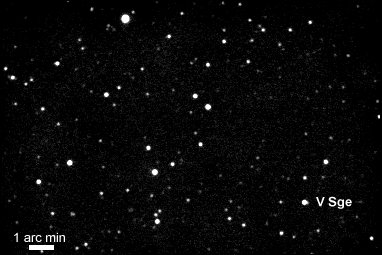 |
| Annotated CCD Image 3 x 30s (average combine), 2x2 binning, C Filter 2008-06-26 01:24hUT (#292135-41) |
| V Sge - reference stars |
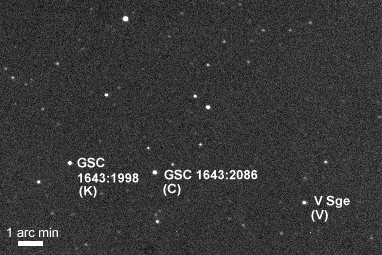 |
| Annotated CCD Image 30s, 2x2 binning, V Filter 2008-06-26 01:24hUT (#292137) |
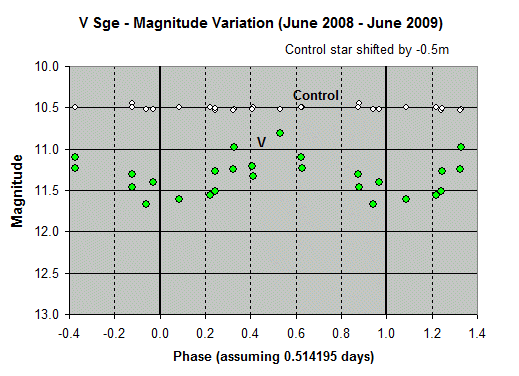
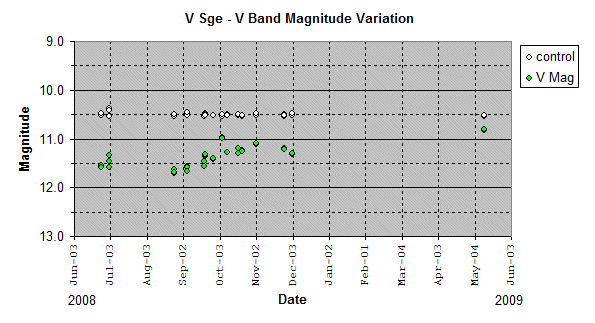
| V Sge - variation |
 |
 |
Back to Top
Algol (Beta Persei)-type eclipsing systems. Binaries with spherical or slightly ellipsoidal components. It is possible to specify, for their light curves, the moments of the beginning and end of the eclipses. Between eclipses the light remains almost constant or varies insignificantly because of reflection effects, slight ellipsoidality of components, or physical variations. Secondary minima may be absent. An extremely wide range of periods is observed, from 0.2 to >= 10000 days. Light amplitudes are also quite different and may reach several magnitudes.
Back to Top
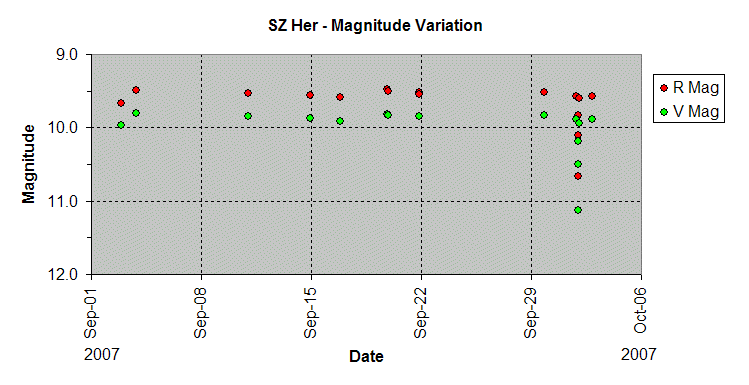
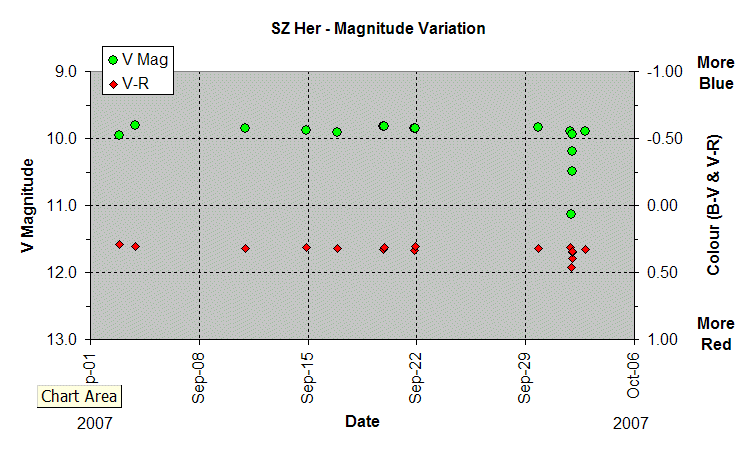
Measurements being made in V, R filters.
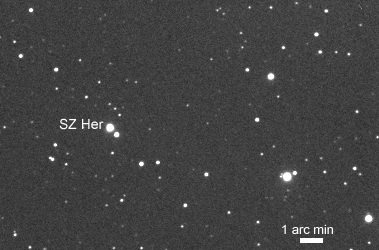
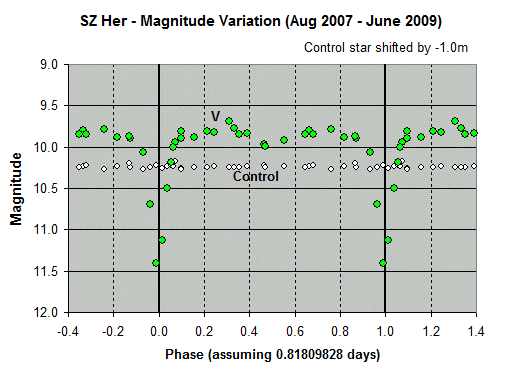
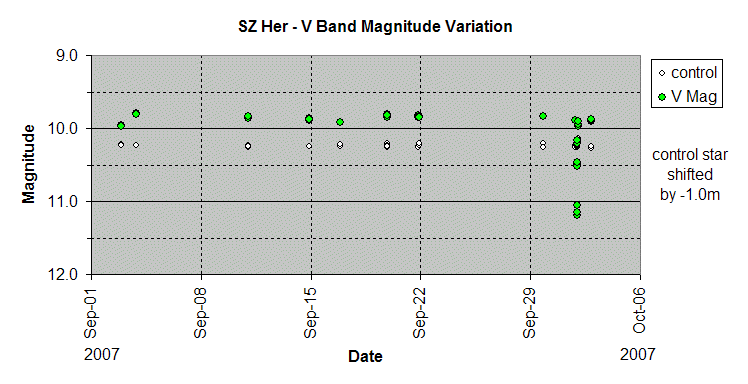
| SZ Her (Hercules) Catalog period 0.81809828 days (19h 38m) Mag +9.86 (min +11.87) |
|
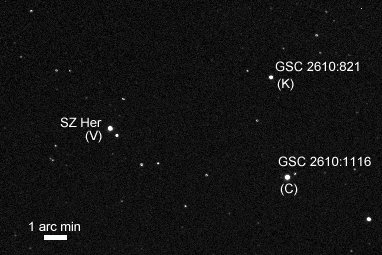
| Annotated CCD Image 3 x 60 sec exposure (average combine), 2x2 binning, C Filter 2007-09-02 21:28h UT (#209062-68) |
| Reference Stars |
|
| Annotated CCD Image 60 sec exposure, 2x2 binning, V Filter 2007-09-02 21:25h UT (#209063 |
| SZ Her variation |
 |
 |
 |
 |
Back to Top
|
U Sge (Sagitta) |
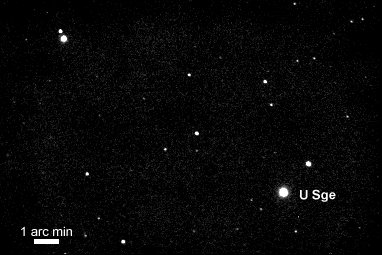 |
| Annotated CCD Image 3 x 15s exposure (average combine), 2x2 binning, C Filter 2008-05-09 01:50h UT (#287234-40) |
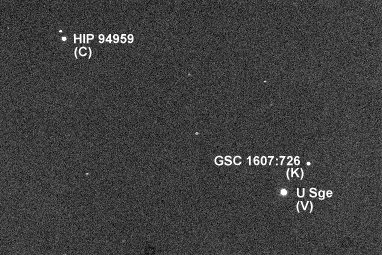
| U Sge - reference stars |
|
| Annotated CCD Image 15s exposure, 2x2 binning, V Filter 2008-05-09 01:50h UT (#287242) |
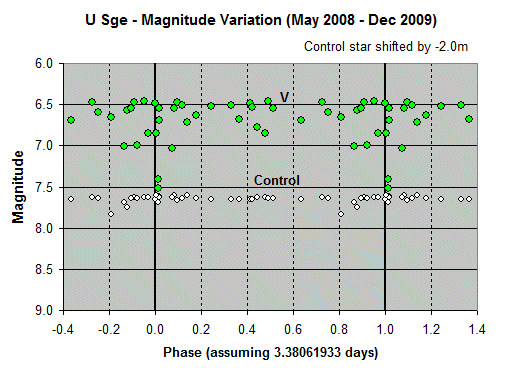
| U Sge - variation |
|
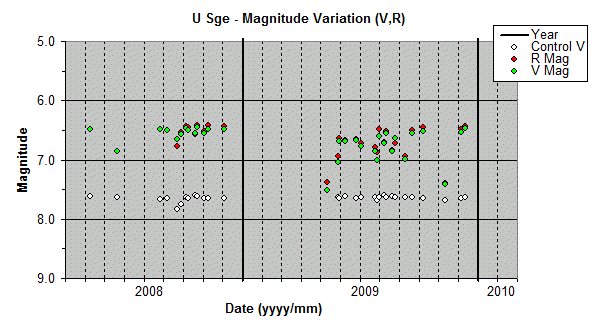
|
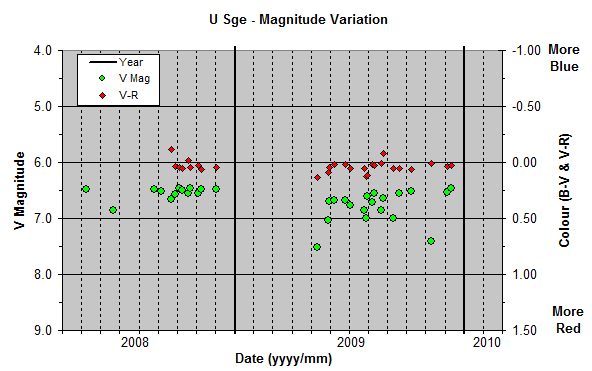
|
Back to Top
Beta Lyrae-type eclipsing systems. These are eclipsing systems having ellipsoidal components and light curves for which it is impossible to specify the exact times of onset and end of eclipses because of a continuous change of a system's apparent combined brightness between eclipses; secondary minimum is observed in all cases, its depth usually being considerably smaller than that of the primary minimum; periods are mainly longer than 1 day. The components generally belong to early spectral types (B-A). Light amplitudes are usually <2 mag in V.
Back to Top
|
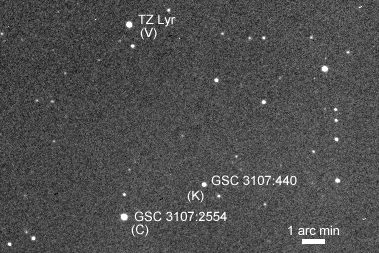
TZ Lyr (Lyra) - Reference Stars |
|
|
| Annotated CCD Image 3 x 30s sec exposure (average combine), 2x2 binning, V Filter 2007-10-22 23:42 h UT (#224271-75) |
|
|
|
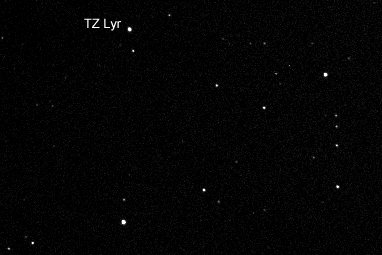
Earlier Image of TZ Lyr from 2006 |
|
|
|
|
|
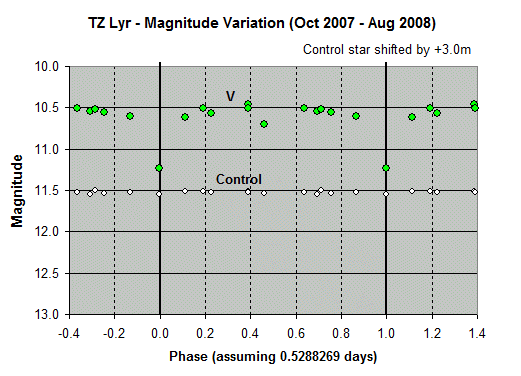
TZ Lyr - variation |
|
|
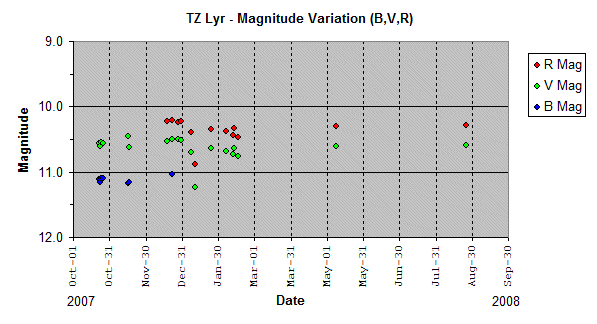 |
Back to Top
W Ursae Majoris-type eclipsing variables. These are eclipsers with periods shorter than 1 days, consisting of ellipsoidal components almost in contact and having light curves for which it is impossible to specify the exact times of onset and end of eclipses. The depths of the primary and secondary minima are almost equal or differ insignificantly. Light amplitudes are usually <0.8 mag in V. The components generally belong to spectral types F-G and later.
Back to Top
Binary systems with one or both giant and supergiant components; one of the components may be a main sequence star.
Binary systems having, among their components, nuclei of planetary nebulae. Example: UU Sge.
RS Canum Venaticorum-type systems. A significant property of these systems is the presence in their spectra of strong Ca II H and K emission lines of variable intensity, indicating increased chromospheric activity of the solar type. These systems are also characterized by the presence of radio and X-ray emission. Some have light curves that exhibit quasi sine waves outside eclipses, with amplitudes and positions changing slowly with time. The presence of this wave (often called a distortion wave) is explained by differential rotation of the star, its surface being covered with groups of spots; the period of the rotation of a spot group is usually close to the period of orbital motion (period of eclipses) but still differs from it, which is the reason for the slow change (migration) of the phases of the distortion wave minimum and maximum in the mean light curve. The variability of the wave's amplitude (which may be up to 0.2 mag in V) is explained by the existence of a long-period stellar activity cycle similar to the 11-year solar activity cycle, during which the number and total area of spots on the star's surface vary.
Systems with white-dwarf components.
Systems having Wolf-Rayet stars among their components. Example: V 444 Cyg
Back to Top
AR Detached systems of the AR Lacertae type. Both components are subgiants not filling their inner equipotential surfaces.
Detached systems, with components not filling their inner Roche lobes
Detached main-sequence systems. Both components are main-sequence stars and do not fill their inner Roche lobes.
DS Detached systems with a subgiant. The subgiant also does not fill its inner critical surface.
DW Systems similar to W UMa systems in physical properties (KW, see below), but not in contact.
Contact systems, both components filling their inner critical surfaces.
Contact systems of early (O-A) spectral type, both components being close in size to their inner critical surfaces.
Contact systems of the W UMa type, with ellipsoidal components of F0-K spectral type. Primary components are main-sequence stars and secondaries lie below and to the left of the main sequence in the (MV,B-V) diagram.
Semidetached systems in which the surface of the less massive component is close to its inner Roche lobe.
Back to Top
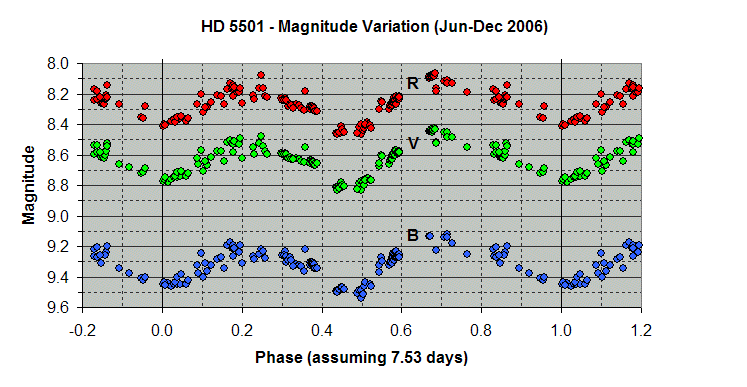
Measurements being made in B, V, R filters as part of an ongoing study on variable behavior of this suspected eclipsing variable..
|
HD 5501 (Cassiopeia) |
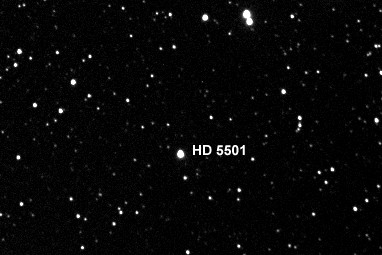 |
| Annotated CCD Image 30 sec exposure, 2x2 binning, C Filter 2006-04-23 21:49h UT (#116018) |
|
Approximate Colour Image of HD 5501 |
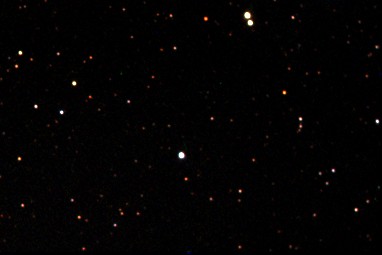 |
| Approximate Colour CCD Image Red : 2 x 30 sec (R), Green : 2 x 30 sec (V), Blue : 2 x 60 sec (B), 2x2 binning 2006-04-23 21:53h UT (#116020-25) |
 |
Back to Top
| This Web Page: | Eclipsing Variable Stars |
| Last Updated : | 2015-05-15 |
| Site Owner : | David Richards |
| Home Page : | David's Astronomy Web Site |